Showing posts with label Books. Show all posts

Monday, February 1, 2021

The Politics of Book Reviews

“If nobody talks about books, if they are not discussed or somehow contended with, literature ceases to be a conversation, ceases to be dynamic. Most of all, it ceases to be intimate. It degenerates into a monologue or a mutter. An unreviewed book is a struck bell that gives no resonance. Without reviews, literature would be oddly mute in spite of all those words on all those pages of all those books.” 

~ Patricia Hampl 

The reality of the publishing industry today, particularly for indie authors and
writers with small publishers is that gaining recognition in a crowded marketplace with hundreds of new titles released every other month, has become a struggle. Getting written reviews on such websites as Amazon and Goodreads, therefore, is an excellent way of making their work stand out. Unfortunately, though, it can also be the quickest way to get their work trashed, and their reputation as authors tarnished by toxic reviewers. In recent days, stories have proliferated online that some trolls on Goodreads who’ve been posting one-star reviews on books, sometimes without even reading them, have demanded payoffs from authors to remove them.

Authors have no control over what readers think of their work, and that’s fine as long as readers are honest. Honesty, in this context, does not necessarily mean positive feedback, but it also doesn’t have to mean an unwarranted attack on the author. While criticism is an integral part of publishing, a dislike for a particular book does not justify ridiculing its author. In the same vein, a writer’s crave for recognition does not justify paying for positive reviews. Not only does this mislead potential readers, but it also deprives the authors themselves of a fair and balanced appraisal of their work. As the American journalist, Jack Shafer noted in his 2005 piece, Fair Is Square, “… book reviews aren’t yearbook photos for authors to treasure. They are for readers.”

But that appears to be a memo some authors have not received. Not only do they indulge in the now frowned upon practice of review swaps, some, ignoring the reputable review groups on Goodreads, partake in toxic review exchange groups online where, as someone puts it, “anything less than a four-star review is flat-out rejected and considered harsh and unhelpful.” The trouble with this practice is that those who relish being flattered by their fellow authors deny themselves the chance to learn of any structural weakness in their work that might need attention. Since books are written for the public, eventually, real people will buy them, and if they find such books to be mediocre works, not only will the authors lose credibility, but they’ll have to face the disappointment of their readers which might manifest itself in angry one-star reviews on Amazon. If many readers, decrying the deception, leave such reviews, it’d inevitably call the authenticity of the earlier positive reviews into question.

Another negative aspect of certain review exchange groups is that since members do not get to choose the books they must review, some end up with genres they have no affinity for, which often deprives the book’s author of unbiased feedback. It is also interesting to note that outside of these review exchange groups, while authors crave positive reviews from readers, they are sometimes not equally generous in their reviews of other writers’ works. There are cases in which authors take issue with certain characters in a book, and strangely enough, based their review of the book on the bias they have towards the character rather than on the literary merit of the book. 

Now the industry is riddled with so much bias that some readers claim they are no longer swayed by the reviews they read on Amazon or Goodreads. Having bought books on the strength of the starred reviews, only to find the writing quality wanting, a new reality is dawning on many readers. Yet, these starred reviews continue to determine which books are promoted, and to some extent, which ones are bought. Fairness—once the hallmark of literary assessment of 
fictional works—has been thrown out the window, and replaced by an obsession with star numbers, resulting in the exaltation of 5-star reviews as a sign of literary excellence while all the others are considered worthless, except perhaps 4-star reviews which are generally accepted as just fine. One fact, though, remains unchangeable - if a book has no literary merit, its five-star reviews—be they from friends and family or from literary magazines that thrive on paid reviews—can not give it the core it lacks. And if a book is excellent, no single-star review posted by a biased reviewer or by a disgruntled author envious of another’s work can rob it of its substance.


Saturday, November 14, 2020

From the Horse's Mouth:

Authors on Writing


Writers, like seasoned comedians, know, not only how to take a swipe at their profession but also how
 to poke fun at themselves. Sarcasm, self-mockery, and half-truths are some of the ways by which writers offer the public an insight into their take on themselves and the art of writing. When Thomas Mann said that “A writer is someone for whom writing is more difficult than it is for other people,” he was acknowledging, with great cunning brilliance the complexity of the art of writing even for those who do it for a living. 

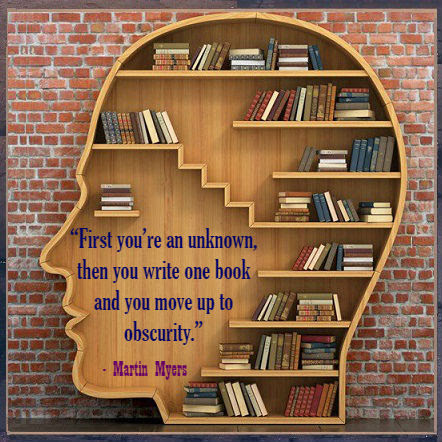
Not that poking fun at oneself requires artfulness or subtlety, sometimes straight talk does it just as well. Take Charles Dickens who neither minced words nor offered a tongue in cheek aside when deriding the work of other writers. “There are books of which the backs and covers are by far the best parts,” or Martin Myers who threw in a remarkable self-own, “First you’re an unknown, then you write one book and you move up to obscurity.” Sometimes funny and sometimes delightfully direct, here are writers in their own words:

“There is no idea so brilliant or original that a sufficiently-untalented writer cant screw it up.” ~ Raymond Feist

“A blank piece of paper is God’s way of telling us how hard it is to be God.” ~ Sidney Sheldon

“This morning I took out a comma and this afternoon I put it back again.” ~ Oscar Wilde


“I just sit at my typewriter and curse a bit.” P.G. Wodehouse

“The first draft of anything is shit.” ~ Ernest Hemingway

“There is no mistaking the dismay on the face of a writer who has just heard that his brainchild is a deformed idiot.” ~ L. Sprague de Camp

“Cut out all these exclamation points. An exclamation point is like laughing at your own joke.” ~ F. Scott Fitzgerald

“Inspiration is a guest that does not   willingly visit the lazy.” ~ Pyotr Tchaikovsky

“Some stories have to be written because no one would believe the absurdity of it all.” ~ Shannon L. Alder

“When a work appears to be ahead of its time, it is only time that is behind the work.” ~ Jean Cocteau

“There are three difficulties in authorship: to write anything worth publishing -- to find honest men to publish it -- and get sensible men to read it.” Charles Caleb Cotton

“There is no idea so stupid or hackneyed that a sufficiently-talented writer can't get a good story out of it.” ~ Lawrence Watt-Evans

“Writing is a socially accepted form of schizophrenia.” ~ E.L. Doctorow

“Most editors are failed writers - but so are most writers.” ~ T.S. Eliot

Sunday, January 26, 2020

Quotes To Live By

“If you are lucky enough to find a way of life you love, you have to find the courage to live it.” 

   - John Irving

  
“Without wearing any mask we are conscious of, we have a special face for each friend.”
- Oliver Wendell Holmes, Sr.


“We are all in the gutter, but some of us are looking at the stars.”

- Oscar Wilde
“Obstacles are things a person sees when he takes his eyes off his goal.”

- E. Joseph Cossman


“The artist is nothing without the gift, but the gift is nothing without work.” 

 - Emile Zola


“The future is like heaven, everyone exalts it, but no one wants to go there now.”  
    
- James Baldwin

“There is no greater agony than bearing an untold story inside you.”

- Maya Angelou


“It’s easy to sit up & take notice. What’s difficult is getting up & taking action.” 

- Honore de Balzac


“A great artist is always before his time or behind it.”

   - George Edward Moore 


If you judge a book by the cover you might miss an amazing story


Sunday, October 13, 2019

Creative Writing - Challenges & Drawbacks

✍️ “Writing is so difficult I often feel that writers, having had their hell on earth, will escape all punishment thereafter.”
~ Jessamyn West

       The Downside of Studying Creative Writing


I studied Creative Writing for my undergraduate degree and continued studying it into my postgraduate degree.  I am proud of my degrees and I enjoyed studying the process of writing, but as with everything, there are downsides to studying Creative Writing.
Studying Creative Writing isn’t as simple as writing a story and getting a grade for it. Pieces are marked on their originality, their use, and control of language, and your ability to explain your writing process.  You must approach your writing from an academic perspective whilst maintaining the creativity that you need to carve a piece out of a blank piece of paper (or screen).  Studying Creative Writing is not a walk in the park, nor is it for people who class Fifty Shades of Grey as the greatest book ever written.

It Can Take the Pleasure Out of Reading

Once you know the technical rules of writing, it becomes hard to sit and enjoy a book — particular a mainstream one that was written/bought for the sake of profit, not because of its quality.  The rules that you’ve learned studying Creative Writing will make it difficult for you to switch off your editor mode, meaning that unless a book is incredibly well written, you won’t be able to help but dissect it.
Some courses also contain Literature modules — you can also study Creative Writing with Literature — and those modules are often compulsory.  It is impossible to study writing and not change the way that you approach reading particularly once you have begun to workshop.

It Can Take the Pleasure Out of Writing

Before studying writing, Meg Cabot was warned that it would take the fun out of it for her.  You have to really love writing to study it.  Not only that, but you have to make sure to study the right kind of writing for you — if you’re a poet and you don’t feel comfortable
"There are really only two reasons to write: desperation or revenge." 
~ Elizabeth Hardwick
writing short stories, make sure to go somewhere that you can focus on poetry and won’t be forced to write things that you’re uncomfortable with.  It’s good to experiment, but if you already know which area(s) you enjoy writing the most, don’t study the areas you enjoy less — you’ll go from less fun to no fun.
The more we’re forced to do something, the harder it is for us to enjoy it: our appetite for it can become saturated to the point where it’s no longer fun.  If you’re worried about this happening to you, think about how you approach writing.  Do you do it for fun?  Is it a hobby for you, or is it your life?  If you approach everything in life and think about what angle you could approach it from were it a piece of fiction or a poem, or you carry a notebook around for ideas, studying Creative Writing may well be for you.

Commentaries

Speak to anyone that’s studied or is studying Creative Writing, and most — if not all — will go off on a five-minute rant about how annoying commentaries are.
Commentaries go hand-in-hand with studying Creative Writing and often amount to 50% — possibly even more — of a grade.  They are just as important as your creative work, sometimes even more.  In commentaries, you have to justify why you’ve made certain creative decisions, referencing theories that back up your choices.
Commentaries are an entirely different skill to creative work.  They’re much closer to essay writing than short stories, scripts or poetry.  If you’re planning on doing any form of degree in Creative Writing, writing commentaries will be mandatory and will go with most pieces of creative work that you submit.  If you’re not comfortable writing essays, I would seriously think before deciding to study Creative Writing.

Workshopping

Workshopping is one of those things that you either enjoy or you don’t.  Many people — particularly if they’re new to writing — dread them.  They’re intimidating environments,
particularly if some or all of the people you’re workshopping with have more experience in writing than you do.
Writing is seen as a solitary craft, and the initial process is, but if you wish to improve, it is necessary to workshop, and workshop as much as you possibly can.  The more people you workshop your work with, the more perspectives you’ll get.  The more perspectives you get, the more likely you are to find things to change or to find out how people interpret your work (and it may not be how you intended).
If you don’t enjoy group work, workshops can be difficult.  Likewise, it might be the way that the workshop is led that you’re uncomfortable with.  There are many ways to lead a workshop, and many ways to give and receive feedback.  How it’s done will depend on where you study, who your teachers are, and what your peers are like.

Some Teaching Methods

The place that you choose to study Creative Writing will have a huge impact on you.  Some of it will be conscious, some of it won’t be.  Some places are much more involved in the local — and wider — literary community, and those places are where you want to go because it will help you long-term as well as short-term.
Like with everything we study, how something is taught to us can and will affect our opinion and approach.  Do your research on where you want to study before you decide, because some places have a focus on certain areas such as fiction, whereas others will be more diverse.

Conclusion

Studying Creative Writing isn’t for everyone.  Just because you love writing, that doesn’t mean you’ll enjoy studying it.  That’s ok — studying Creative Writing is much more academic than many people think.  It’s also much more difficult.
It may seem like I’m against people studying Creative Writing, but this isn’t the case.  I enjoyed and am proud of my degrees, and wouldn’t have chosen to do a postgraduate degree in Creative Writing if I didn’t enjoy it.  However, I have seen many people fail or drop out because they choose the course as an easy option, or they pick it because they had an idea for a story.  Having an idea for a story is not enough to study Creative Writing — there is much more to creative writing than just one story.  To study it, you must have a never-ending supply of ideas that you can dip in and out of at any time.  If you struggle to come up with new ideas every week, you may be better working on your sources of inspiration before you look into honing your craft.
If you’d like to pursue creative writing but I’ve put you off above, why not consider joining a writing group instead?  Writing groups are much more laid back, and there’s less pressure because there’s no assessment involved.  You can still meet like-minded people, but with the pressure off it gives you more time to hone your skills and less time working on essay writing.
Did you study Creative Writing?  Did it take the fun out of writing for you, or did it make you love it more?
The Alliance of Independent Authors - Author Member
Kristina Adams is an author of fiction and nonfiction, writing and productivity blogger, and occasional poet. She has a BA in Creative Writing from the University of Derby and an MA in Creative Writing from Nottingham Trent University. She can be found under a pile of books with a vanilla latte.

Sunday, February 3, 2019

Author Recipe

FOOD, FICTION, FOOLISHNESS

When author Ann Everett scheduled Augustine Sam for her Food, Fiction, and Foolishness feature, she didn’t know he’d submit a spaghetti recipe, which she said was fancier than the one she posted weeks earlier. To help her American fans understand the recipe, she offered a link to the gourmet sleuth website for conversion to U.S. measurements and said she loved that the author used a photo of himself in the foolishness section. Oh, she loved the funny quote too!

FOOD 


Recipe: Spaghetti alla Carbonara

Ingredients:

Spaghetti  -  about 400g
Pancetta   -  about 200g (bacon)
Egg yolks  -  about 4
Pepper      -  q.s. quantum sufficit (whatever’s enough)
Salt            -  q.s.   
Oil              -  q.s.
Pecorino   -  about 50g (Italian sheep’s milk cheese)

Preparation:
1)  Cook the spaghetti in boiling water with little salt. The pasta should not be too soft or overdone, it should, instead, be cooked to be firm to the bite (“al dente” in Italian).
2) In the meantime, cut the bacon or pork cheek into cubes, letting it dissolve in a pan with little oil.
3) When the bacon or cheek lard fat partially melts, add a little water and cook over moderate heat for about ten minutes.
4) Beat the egg yolks in a salad bowl, as if to make an omelet, add the Pecorino cheese and a pinch of black pepper.
5) Mix the ingredients: Pour the bacon or cheek lard over the spaghetti cooked “al dente”, and add the beaten egg yolks prepared with the cheese, mixing them until they are firm, then serve your Spaghetti alla Carbonara hot. 

FICTION 

The saga of a compelling backward journey through a broken mind

Paige Lyman, an accomplished psychiatrist, is on the verge of madness but she doesn’t know it yet. The madness begins when she gets it into her head to write her memoirs. As her brilliant mind assembles bits and pieces of her life for the book, ugly skeletons, long forgotten in the closet, begin to rear their heads.

It had all begun with a simple act of love. And love, for her, was a blond-haired Irish boy named Bill, so when Bill abandoned her for priesthood the world around her collapsed. Now seized by a different passion—vengeance—she seeks her proverbial pound of flesh in the beds of various priests.

But that’s before she meets Stern W. And now, she’s transformed from a psychiatrist to a patient, and saddled with dark memories she must decipher in order to be free…    


FOOLISHNESS

Funny Book quote:

“Always read stuff that will make you look good if you die in the middle of it.” - P.J. O’Rourke

Saturday, August 11, 2018

Inspirational Thoughts

“People were created to be loved. Things were created to be used. The reason the world is in chaos, is because things are being loved, and people are being used.”

- Unknown


“Be more concerned with your character than your reputation, because your character is what you really are, while your reputation is merely what others think you are.” 


 - John Wooden


“Art cannot be modern. Art is primordially eternal.”
-  Egon Schiele

“A great artist is always before his time or behind it.” 
- George Edward Moore


To send light into the darkness of men’s hearts - such is the duty of the artist. 
- Robert Schumann

“Poetry is what in a poem makes you laugh, cry, prickle, be silent, makes your toe nails twinkle, makes you want to do this or that or nothing, makes you know that you are alone in the unknown world, that your bliss and suffering is forever shared and forever all your own.”

- Dylan Thomas

“Learn from yesterday, live for today, hope for tomorrow. The important thing is not to stop questioning.” 

- Albert Einstein


To choose doubt as a philosophy of life is akin to choosing immobility as a means of transportation.

Yann Martel


“Even if you’re on the right track, you’ll get run over if you just sit there.” 
- Will Rogers.